The short answer
If you sell software to mid-market SaaS companies, ZoomInfo and Apollo are excellent. If you sell treatment technology, equipment, or services to wastewater facilities, they will frustrate you — not because they are bad products, but because their unit of data is the company, and your unit of opportunity is the facility.
A municipality is one "company" in a generic database. It might operate four treatment plants with completely different technologies, permit situations, and upgrade budgets. The thing that tells you whether there is a deal — an aging lagoon, a string of NPDES violations, a funded capital improvement project — simply is not a field that generic databases collect.
What ZoomInfo and Apollo do well
Credit where it is due. The generic platforms are strong at:
- Breadth: tens of millions of companies and contacts across every industry
- Contact data: direct dials, verified emails, job-change alerts
- Workflow: built-in sequencing, dialers, CRM sync, intent signals
- Price flexibility: Apollo in particular has accessible entry tiers
If your wastewater go-to-market is purely "find people with a certain job title at utilities and email them," a generic tool will get you names. The problem is what happens next.
Where they fall short for wastewater
Wastewater sales teams using generic databases typically hit four walls:
- No facility mapping. You cannot search for "activated sludge plants above 5 MGD" or "lagoon systems in the Midwest" — the concept of a treatment facility does not exist in the data model.
- No operational data. Treatment technology, design flow, discharge permits, compliance history, digesters, sludge handling — none of it is there. Yet this is exactly what qualifies or disqualifies a prospect for your solution.
- No buying triggers. A facility entering serial non-compliance, a permit renewal, or a funded CIP project is what creates urgency in this industry. Generic intent data (someone read an article about "water treatment") is far weaker.
- Manual qualification remains. Your team still spends hours cross-referencing EPA ECHO, state databases, Google Maps, and city budget PDFs to figure out whether each lead is real. The most expensive part of prospecting is untouched.
What Klarifi does differently
Klarifi was built facility-first. We take the publicly available data from environmental protection agencies like the US EPA, clean it, and enrich it with aerial imagery analysis and validated contact details — so you can search 200,000+ wastewater facilities by the things that actually define your target market:
- Treatment technology (activated sludge, lagoons, digesters, membranes, and more)
- Facility size and discharge volumes
- Compliance and violation history, updated weekly for NPDES facilities
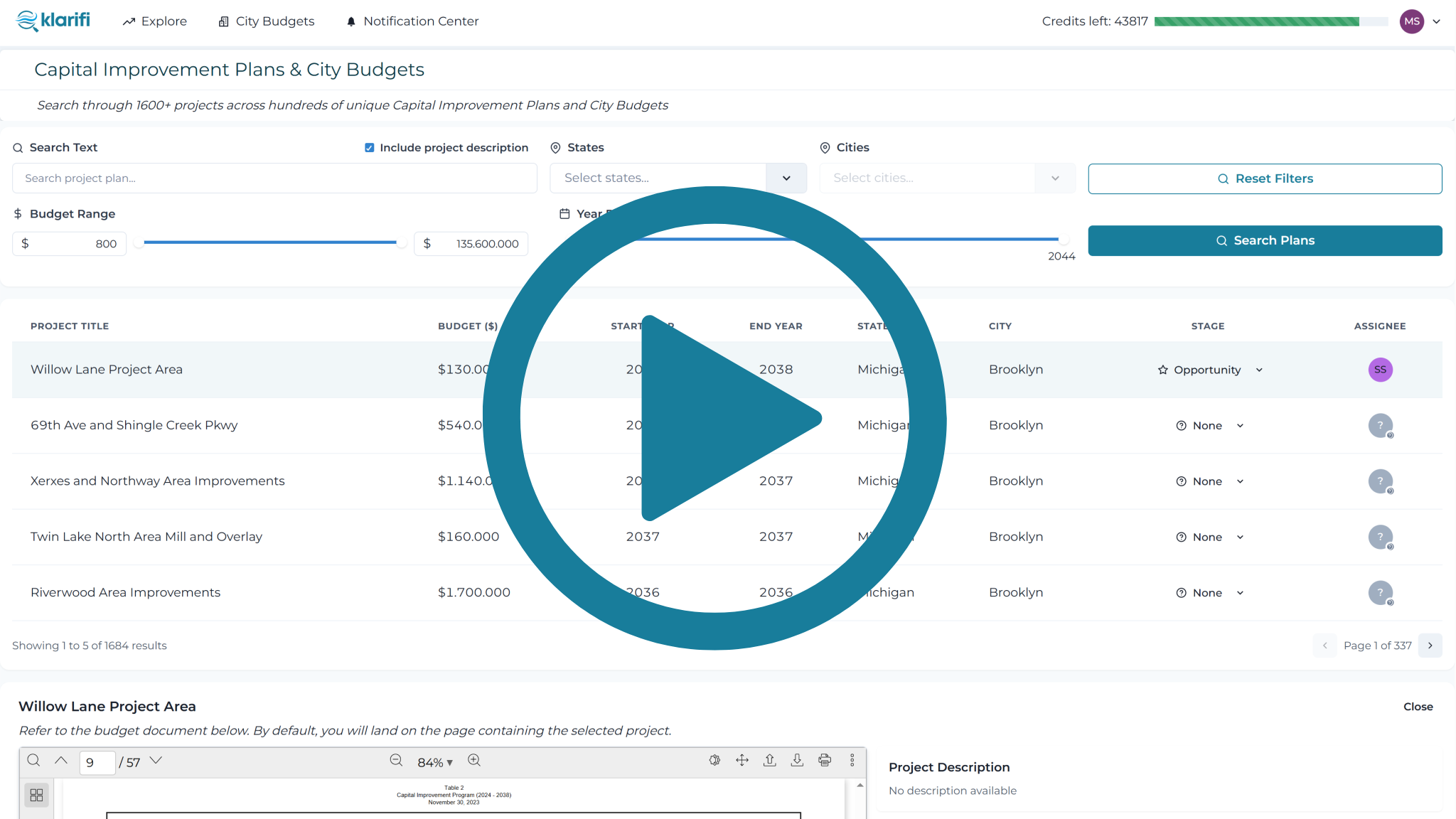
- City budgets and capital improvement plans (CIPs)
- Validated contacts at the facility and decision-maker level
The result is that qualification happens in the search itself. One of our customers, Arvia Technology, ran a campaign built on Klarifi data that produced eight opportunities and four sales.
What about the industry-specific tools?
The generic databases are not the only alternative. Three industry players come up regularly in our conversations, and each is genuinely good at what it was built for — which is not the same thing Klarifi was built for.
- Industrial Info Resources (IIR) tracks industrial capital and maintenance projects globally, including thousands of wastewater-related projects at industrial plants. If you sell into large industrial capital projects across many sectors, IIR's project database is a serious tool. It is project-first and enterprise-priced; it is not built for systematically prospecting municipal treatment facilities by technology and compliance situation.
- Global Water Intelligence (GWI) is the reference for water-market research: market sizing, forecasts, competitive analysis, and global project trackers. GWI answers strategy questions — "how big is this market, where is it growing" — brilliantly. It is not a prospecting database with facility-level operational detail and validated contacts for your SDRs to work through.
- Citylitics is the closest comparison: it mines public documents (capital improvement plans, budgets, meeting minutes) to surface early-stage infrastructure project signals across water, wastewater, and other public infrastructure. If your sales motion is pursuing funded capital projects 1–5 years out, it is a strong fit. Klarifi starts from the facility instead of the project: what technology runs there, how it is performing against its permit, who operates it — the signals that matter when your solution addresses an operational problem rather than a budgeted construction project. Klarifi also goes one step further down the funnel: we can run the outreach itself.
In short: IIR for industrial capital projects, GWI for market strategy, Citylitics for public infrastructure project pursuit — and Klarifi when you need to find, qualify, and actually engage wastewater facilities as customers.
Side-by-side comparison
- Wastewater facility mapping — Klarifi: yes. ZoomInfo/Apollo: no.
- Facility-level operational data (technology, flow, permits) — Klarifi: yes. ZoomInfo/Apollo: no.
- Compliance history and buying triggers — Klarifi: yes, updated weekly for NPDES facilities. ZoomInfo/Apollo: no.
- Contact details — Klarifi: yes, validated twice a year, facility-linked. ZoomInfo/Apollo: yes, broad coverage.
- Prospect qualification — Klarifi: built into the search. ZoomInfo/Apollo: manual, outside the tool.
- Outreach execution — Klarifi: campaigns module, plus the done-for-you Klarifi Plus tier covering LinkedIn, email, and phone calls on your behalf. ZoomInfo/Apollo: strong native sequencing, but you run it yourself.
- Industries covered — Klarifi: wastewater, deeply. ZoomInfo/Apollo: everything, shallowly.
Can you combine them?
Absolutely — and some teams should. A sensible split: use Klarifi to decide who to target (facilities whose technology, size, and compliance situation match your solution) and use your existing CRM or sales engagement tool to manage how you engage them. If you would rather not run the engine room at all, Klarifi Plus handles prospecting, campaign drafting, and outreach for you — LinkedIn, email, and phone calls, all in your name — and you take over when a prospect responds. In effect, we become your external wastewater sales specialist, without the overhead cost of building the function in-house.
How to choose
- If wastewater is a side market for you and you mostly need email addresses: a generic database is fine.
- If wastewater facilities are your core market and qualification eats your team's week: you need facility-level data, and that is Klarifi.
- If you want pipeline without hiring an outbound team: look at Klarifi Plus — an external wastewater sales specialist that prospects, writes, emails, and calls on your behalf.
The fastest way to judge is to look at your own territory. Start a free trial and search for the facilities you already know — then look at the ones you didn't.
Frequently Asked Questions
Your one stop shop for wastewater lead generation
for wastewater expertsCity budgets, compliance history, official contacts and more...